How to LTO Car Registration And Get Certificate Of Registration
How to LTO Car Registration And Get Certificate Of Registration. Being a car owner in the Philippines comes with certain privileges, but it also comes with certain responsibilities, most of which require careful attention or financial resources. One of the most important responsibilities apart from obtaining a driver’s license is registering it at the Land Transportation Office (LTO) and obtaining an OR/CR (Land Transportation Office Official Receipt and Certificate of Registration).
The LTO provides easy access for both you and the government to track your motor vehicle when you register it with the agency. If you have completed the registration requirements and obtained a certificate of registration, you can be assured that your vehicle is in good working order and can be driven safely. By following these guidelines, you will ensure that you will not put you or others at risk and that you will avoid legal repercussions as a result of owning an illegal or poor-quality vehicle.
In order to help you take the first step in protecting yourself and others on the road, here is a complete guide on how to register your private car at the LTO for the first time and get your certificate of registration.
What is Motor Vehicle Registration (Car Registration) Philippines
The number one step every car owner is supposed to undertake when it comes to registering their vehicle with the LTO is by registering the vehicle with the LTO. It provides a unique identifier – the registered plate number – that allows the government to establish a link between vehicles and their owners. It is helpful to have a connection such as this for tracking vehicles, especially in the event that they have been lost or used to commit crimes. Furthermore, it ensures that your vehicle is always in excellent condition and ensures that you are never in danger while driving.
New motor vehicles in the Philippines are usually registered for three years at the time of their first registration. The government considers a registered motor vehicle (MV) safe and roadworthy for the first three years following its registration. A failure to register a vehicle can result in serious consequences for car owners, as it can result in fines of up to Php10,000.00 for failure to comply.
There may also be legal repercussions, especially if the vehicle is involved in an accident or is involved in a crime. Non-registration may also result in your vehicle being impounded by the LTO if the authorities determine that the vehicle has been unregistered for more than a month. After that, you will have to keep paying the fines until the vehicle is actually registered.
What is LTO OR/CR ?
The LTO OR/CR stands for the LTO’s Official Receipt (OR) or Certificate of Registration (CR). Documents such as these are of utmost importance if you own or operate a motor vehicle. They not only prove that you have gone through the legal process of getting your vehicle registered, but they also serve as your vehicle’s unique identification number, identifying it from all other vehicles in the country, regardless of any similarities in the make and model, variant, or color of your vehicle. The two also play a significant role in helping the authorities to control the traffic system and reduce crime, such as robberies, accidents, and the like.
LTO OR (Official Receipt)
Land Transportation Office-issued Official Receipts (ORs) are documents that are issued by the Land Transportation Office to car owners when they register their vehicles. One of the documents used to identify a motor vehicle is the vehicle registration, which indicates that the registration fee has been paid.
There is a sky blue LTO logo as the background on the LRO OR, and it is typically used to display the following vehicle information:
- The name of the person who paid the registration fees for the vehicle (Received from),
- Where the payee is located (address),
- Number of the license plate of the motor vehicle,
- Please provide a summary and breakdown of the fees paid,
- The date on which the transaction was completed
- A unique and permanent serial number, the OR number, is assigned to it.
LTO CR (Certificate of Registration)
The LTO Certificate of Registration (LTO CR) is another document issued by the LTO to help identify and distinguish your car from all the others in the country. Like the OR, the CR confirms the ownership of the vehicle. As the other half of the LTO OR/CR, the LTO CR is predominantly yellow in color and contains detailed technical information regarding the vehicle being registered. LTO also issues it following the completion of the MV registration process along with the OR.
A few of the information found on the CR is as follows:
- Complete name of car owner
- Address of the owner
- The car’s specific information includes:
- Car model
- Vehicle of make
- Net capacity
- Chassis number
- Motor number
- Vehicle class
- Gross weight
- Number of cylinders
- Engine displacement
- Total number of passengers
There is no doubt that the OR/CR issued by the LTO is one of the two most important documents for your car and its registration. You, as the vehicle owner, can identify your vehicle with either of these two, which will assist you in tracking your vehicle in the event of an accident or involvement in criminal activity.
Requirements
Following is a list of the documents you will need to bring with you when registering a motor vehicle for the first time. The requirements may vary depending on the type of vehicle you are registering.
Brand New Locally Assembled/Manufactured Completely Built Units (CBUS).
- A copy of the original sales invoice
- Certificates of Insurance that are appropriate
- The original Certificate of Stock Reported (CSR)
- MV Clearance Certificate for PNP-HPG
Brand New Imported CBUs
- The original sales invoice or commercial invoice issued by the country of origin
- Certificates of Insurance that are appropriate
- The original Certificate of Stock Reported (CSR)
- Certificate of MV clearance for PNP-HPG
Tax Exempt
- A commercial invoice or certificate of title issued by the country of origin for a motor vehicle
- Certificates of Insurance that are appropriate
- Payment Certificate from the Bureau of Customs
- A true copy of the tax exemption certificate
- The original Certificate of Stock Reported (CSR)
- The original certificate of clearance for MV from PNP-HPG
- Report of Motor Vehicle Inspection (MVIR) if imported second-hand
- If imported second hand, a Certificate of Compliance to Emission Standards (CCES) is required
Imported Second Hand (Used) Exempted from EO 156/877-A
- The original sales invoice and/or commercial invoice of the motor vehicle, as well as the certificate of title issued by the country of origin.
- Insurance Certificate of Coverage that is appropriate
- A copy of the original Certificate of Stock Reported (CSR)
- A copy of the original Philippine National Police-Highway Patrol Group (PNP-HPG) MV clearance certificate
- MVIR (Motor Vehicle Inspection Report)
- CCES (Certificate of Compliance with Emission Standards)
Imported Second Hand Through No Dollar Importation
- A commercial invoice or certificate of title issued by the country of origin for a motor vehicle
- Certificates of Insurance that are appropriate
- The Department of Trade and Industry-Bureau of Import Services (DTl-BIS) has issued a certified true copy of the authority under the No Dollar Importation.
- Procedural Notice of Seizure and Award. (If BIS has not given authority)
- The original affidavit of first and last importation
- The original Certificate of Stock Reported (CSR)
- MV Clearance Certificate for PNP-HPG
- Inspection report for motor vehicles (MVIR)
- CCES (Certificate of Compliance to Emission Standards)
Imported or Acquired Through Donation
- A commercial invoice or certificate of title issued by the country of origin for a motor vehicle
- Obtain an appropriate certificate of insurance
- Original Donation Deed duly signed by the donor and donee
- A company’s original Secretary’s Certificate or Board Resolution
- The original Certificate of Stock Reported (CSR)
- The original certificate of clearance for MV from PNP-HPG
- MVIR (Motor Vehicle Inspection Report)
- CCES (Certificate of Compliance to Emission Standards)
Locally Manufactured/Assembled Electric Vehicles (New Chassis/Body and with a New Imported Electric Motor)
- A copy of the original sales invoice
- Certificates of Insurance that are appropriate
- The original CSR for the electric motor and chassis
- MV Clearance Certificate for PNP-HPG
Rebuilt with Local Chassis/Body and Used Imported Engine
- Engine, chassis, and body original sales invoice
- Obtain a certificate of insurance that is appropriate
- Affidavit of Rebuilt executed by the owner and/or mechanic with the Technical Education and Skills Development Authority
- A National Certificate 11 (TESDA NC 11) indicating, among other things, the date of completion
- A Certificate of Stock Reported (CSR) for the engine and chassis is attached
- A copy of the original PNP-HPG MV clearance certificate
- Inspection Report for Motor Vehicles (MVIR)
- CCES (Certificate of Compliance with Emission Standards)
Rebuilt with Engine and/or Chassis that are Parts of Previously Registered Motor Vehicles
- The original sales invoice for the body
- Certificate of Insurance with appropriate coverage
- A copy of the original registration certificate and the latest official receipt of registration fees for the engine or chassis
- Affidavit of Full Rebuild executed by the Owner and Mechanic with TES DA -NC 11 stating among other things the date when the work was completed
- The original certificate of clearance for MV from PNP-HPG
- MVIR (Motor Vehicle Inspection Report)
- CCES (Certificate of Compliance to Emission Standards)
How to Process Car Registration in LTO
Having learned the requirements you need to meet to register your car, it is time to determine what steps you need to take to complete the LTO registration process.
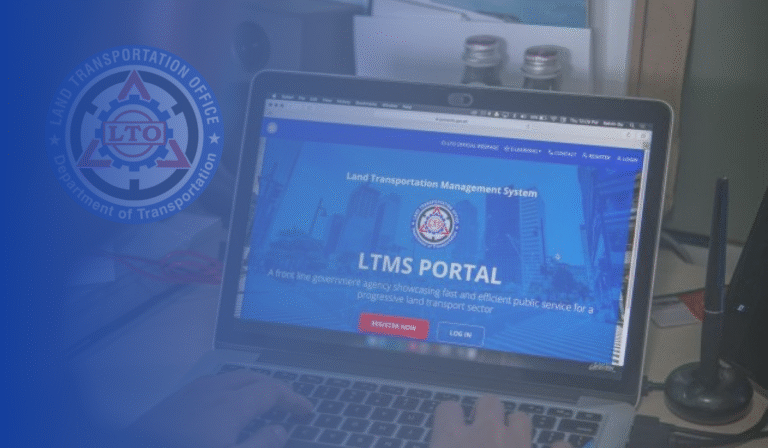
Register a Car Online using LTO LTMS Online Portal
The following steps should be followed if you wish to register your vehicle online through the Land Transport Management System (LTMS) portal of the LTO:
- Step 1: Access the LTO LTMS Portal online.
- Step 2: Access your account, or if you do not have one yet, register for an account on the LTMS portal online.
- Step 3: Upon completion, you will be able to access the LTMS portal for your specific needs with LTO, such as paying traffic violation fines and renewing your car registration.
- Step 4: If you pay fees online, note the payment reference number (PRN).
Note: If you wish to expedite the registration and renewal process for your vehicle, you can schedule an online appointment with your preferred LTO branch.
LTO offices: in person
Follow some steps
- Step 1: Compile and prepare all the documents required for registering the type of motor vehicle you own.
- Note: New cars have different registration requirements depending on their type, whether they are imported, registered locally, registered as light electric vehicles (LEV, AO-2006-01), registered as low-speed vehicles (LSVs), three-wheel vehicles, or tax exempt.
- Step 2: Go to the nearest LTO office that processes new vehicle registrations as not all LTO branches do so.
- Note: If you wish to inquire about whether the nearest LTO branch processes new vehicle registrations, you may always contact the customer service hotline. You will save yourself the trouble of visiting the branch only to find out that car registrations are not processed there.
- Step 3: At the transaction counter, complete the transaction.
- Step 4: Ensure that you submit all the required documentary requirements so the LTO evaluator can assess whether the documents are complete and calculate the fees based on the information they have collected about your vehicle.
- Step 5: Test the motor vehicle in order to determine its emissions level, and submit the Motor Vehicle Inspection Report (MVIR).
- Step 6: Proceed to the cashier and pay all the required fees. Once you have done that, wait for your OR (official receipt).
- Step 7: Once you have completed the process, you will need to wait in line at the Releasing Counter to obtain your Certificate of Registration (CR), plates, and stickers.
Costs and Fees of LTO Car Registration
For the first time, your car registration price can vary depending on a few factors, but it usually costs approximately Php 1,000.00. Additional fees may apply for other items, such as license plates, stickers, vehicle tags, and inspections.
The following fees are associated with these services:
| Item Description | Cost |
|---|---|
| License plate | Php 450.00 |
| Stickers and tags | Php 50.00 each |
| Inspection fees | Php 90.00 to Php 115.00 |
| Penalty fee (if you fail to show up during scheduled registration) | Php 50.00 |
Important Reminders
The following are some things that you should keep in mind when registering your vehicle:
New car registrations are not processed at all LTO branches. It is therefore recommended that you check with the branch you plan to visit in order to ensure that your registration can be processed. Moreover, some LTO branches have different requirements that must be met in order for your application to be accepted. In this regard, you should also inquire ahead of time about any specific requirements so that you can ensure that all documents and other materials are ready at the time of your arrival.
First-time registrations are usually handled by the motor vehicle dealer, although there may be occasions when new car owners have to handle the process on their own.
You will need to pay fees if you fail to register your motor vehicle properly based on the following factors:
- It is important to know what type of vehicle you have
- How long have you been unregistered
- It is important that Pinoy motorists adhere to the schedule or LTO renewal of their car registration, otherwise they may be forced to pay fines ranging from Php 10,000.00 to Php 100,000.00, or worse, the LTO may even impounded the vehicle.
How to Renew Your LTO Registration Online
If you’re asking yourself, “How do I renew my LTO registration online?”, here’s a straightforward process to follow:
- Secure a Certificate of Coverage (COC) from your preferred insurance provider. Once issued, the insurance company will automatically transmit this COC to the LTMS (Land Transportation Management System) electronically.
- Have your vehicle inspected at an accredited Private Motor Vehicle Inspection Center (PMVIC) to ensure it meets road safety standards. After the inspection, the PMVIC will also forward the inspection report directly to the LTMS.
- Log in to the LTMS portal to begin the online renewal of your vehicle registration. You won’t need to manually enter the COC or PMVIC details anymore, as these are already integrated into the system.
- Pay the required fees online. After completing the payment, the system will generate an official receipt and send a copy to your registered email address.
- That’s it! Your vehicle registration is successfully renewed.
Benefits of Registering a Motor Vehicle
The following benefits are yours when you register your vehicle with the LTO:
- Consequently, the LTO and other relevant authorities will be able to track the vehicle more easily and trace it back to you.
- It is possible for them to trace the vehicle back to you if you lose it or end up in an accident.
- The purpose of this is to ensure the roadworthiness of the vehicles
- Poor-quality vehicles contribute to the increase in car accidents.
- Additionally, it prevents car owners from purchasing illegal vehicles.
- It ensures that your automobile remains in good condition and that it is safe to operate upon renewal.
FAQs About LTO Car Registration in the Philippines
Why is it important to register my vehicle with the LTO?
Ans: Registering your car with the Land Transportation Office (LTO) ensures legal ownership, helps trace vehicles used in crimes or accidents, and confirms your vehicle’s roadworthiness. It also protects you from hefty fines, impounding, and legal trouble.
What documents do I need for first-time car registration?
Ans: You’ll typically need an official sales invoice, Certificate of Stock Reported (CSR), insurance certificate, PNP-HPG Motor Vehicle Clearance, and depending on the vehicle type, additional documents like MVIR or CCES.

Can I process my vehicle registration online?
Ans: Yes. Through the LTO LTMS portal, you can register or renew your vehicle by uploading required documents, paying fees, and scheduling branch visits, making the process more convenient.
How much does it cost to register a car in the Philippines?
Ans: First-time registration costs roughly Php 1,000, with additional charges for license plates (Php 450), stickers (Php 50 each), inspection fees (Php 90–115), and possible penalties if you miss deadlines.
What happens if I drive an unregistered vehicle?
Ans: Operating an unregistered vehicle can result in fines of up to Php 10,000 or more, plus possible impounding by the LTO. If your vehicle is linked to an accident or crime, legal consequences escalate.
Conclusion
Registering your car with the LTO isn’t just a legal formality; it’s a safeguard that confirms your ownership, certifies road safety, and protects you against financial and legal risks. By diligently securing your OR/CR, completing inspections, and following the right schedules, you ensure a smooth driving experience and uphold road safety for everyone. Prioritize registration to keep both yourself and others secure on Philippine roads.