List of LTO Traffic Signs And Symbols In Philippines – LTO Traffic Signs

List of LTO Traffic Signs And Symbols In Philippines. Learning about traffic signs and symbols is one of many requirements imposed by the Land Transportation Office (LTO) before issuing a driver’s license. Not only does it assist you in passing the LTO examinations, but it also contributes to the safety of you and others on the road. Even though accidents do occur from time to time, knowing your way on the road and understanding the traffic signs can assist you in avoiding them.
While it is impossible to determine whether the people who did not follow the road signs and traffic rules did not know them, we know that being on the road automatically makes you responsible for other people’s lives. In order to refresh your knowledge or simply learn more about road traffic signs and symbols, we have prepared this guide to the most common road traffic signs and symbols.
LTO Traffic Signs And Symbols
What are Road Traffic Signs and Symbols
There are many road traffic signs and symbols on the road that are designed to guide motorists and pedestrians to their desired destinations. The purpose of these devices is to ensure their safety while they are travelling on public roads. Both pedestrians and drivers are required to follow these signs. They usually provide either a direction, a warning, or an instruction. Generally, road signs are located on the sides of the road, however some are also visible above the roads, on the pavements, and on bridges.
The traffic signs in the Philippines have been designed to be simple, striking, and easy to interpret. This is why it is usually written in large letters or illustrated with pictures or symbols. There are even instances in which they are translated into Filipino or the local dialect, so as to ensure that locals are able to understand them. Whatever the case, these signs were designed in such a manner that no one will be misled by their meaning.
There is an official typeface for signs in the Philippines called Clearview. Design, on the other hand, is standardized but reflects some influences from America, Australia, and the Vienna Convention. It is regulated by the Department of Public Works and Highways (DPWH) to ensure that no changes are made to signs or symbols regardless of their location.
Complete List of Road Traffic Signs and Symbols in the Philippines
There are a variety of road and traffic signs and symbols in the Philippines, and the LTO encourages drivers to become familiar with them by heart to stay safe.
There are eight different categories of traffic signs, including:
Regulatory Signs
As the name suggests, regulatory signs in the Philippines provide information regarding traffic laws. Traffic signs provide guidance and assist in managing traffic flow, as well as informing motorists and road users of traffic laws and regulations. The term also refers to the commonly understood signs that motorists are expected to obey, otherwise they will constitute an offense, which can lead to financial penalties and fines.
The following are six different types of regulatory traffic signs and they are as follows:
1 Priority Signs
Stop Sign
There is a designated stop line on this sign that requires the driver to stop. The stop line is also 6 meters away, so they cannot park there.

Give Way Sign
The driver is expected to yield to the vehicles on the right side of the intersection when this sign is displayed.

Left Turner Must Give Way
If you are turning left at an intersection, you can only have the right of way if you use your turn signal at least 30 meters prior to the intersection. In the case of cars approaching or already too close to the intersection, please yield, make an allowance, or stop and allow them to pass.

2. Direction Signs
Traffic direction signs, as their name suggests, indicate the only direction that motorists must follow. Typically, these signs consist of white arrows over a circle with a blue label in a rectangle.
Pass either side

No turns

One Way

Keep right

Keep left

All traffic must turn right

All traffic must turn left

Merging traffic

Two-way traffic

Salubong na trapiko

Right lane must turn right

Left lane must turn left

3. Prohibitive/Restrictive Signs
A prohibited or restrictive sign indicates the direction(s) in which the motorist or pedestrian should proceed. By displaying a slash symbol, these signs indicate which routes are not allowed to be entered on certain roads.
No entry for all type of vehicles

No entry for all cars

No entry for all jeepneys

No entry for all buses

No entry for all trucks

No entry for all bicycles

No entry for all motorcycles

No entry for all tricycles

No entry for all vehicles with trailer

No entry for all animal-drawn vehicles

No entry for all pushcarts

No pedestrian crossing
Crossing the road is not allowed for pedestrians.

Use Overpass
Pedestrians must use overpasses.

Use Ped Xing
Pedestrians must cross at pedestrian crossings.

No Right Turn
Vehicles cannot turn right.

No Right Turn
Vehicles cannot turn right.

No U-Turn
Vehicles cannot make a U-turn on the road.

No Overtaking Zone

4. Speed Signs
This set of road signs consists of simple signs that tell drivers how fast they are allowed to drive along a particular stretch of road based on the minimum or maximum speed limit.
Maximum speed restriction

End of maximum speed restriction

Speed limit derestriction

Minimum speed restriction

5. Parking and Stopping Sign
If you see these signs, then it means that you may stop a vehicle outside of congested traffic for at least three minutes with or without a driver, whether to park, load or unload passengers.
Zones of parking and loading permitted at particular times and locations
Loading zone, xx:xx AM – xx:xx PM

2P Time restricted parking

Loading and unloading zone

No waiting anytime

Bawal maghintay ano mang oras (No waiting anytime)

No loading and unloading anytime

Bawal magsakay at magbaba (No loading and unloading)

Do not block intersection

No Parking

No Parking – Bawal Pumarada

No Parking – Tow-away Zone

No Parking Anytime from Monday to Friday

Right Turner Crossing at Broken Lines
When turning right within the BUS/PUJ zone, vehicles from the left lane may cross the broken line.

No Stopping Anytime

The following zones are not allowed to park:
No parking – public utility bus stop (Bus Stop Zone)

No parking – public utility jeepney stop (PUJ Stop Zone)

6. Miscellaneous Signs
Here are some other signs that belong to this category:
- Restriction signs for loads and dimensions
No entry for vehicles wider than 2 meters

No entry for vehicles taller than 3.5 meters

There is no entry for vehicles longer than 10 meters

There is no entry for vehicles heavier than 5 tons in gross vehicle mass

There is no entry for vehicles with a gross axle load of more than two (2) tons

Use Seat Belt sign

No Blowing of Horns

Be aware of pedestrian crossing

Be aware of school children crossing

Bike lane ahead

Be aware of Persons with Disabilities (PWD) crossing

Warning Signs
This category of LTO traffic signs was created to alert motorists and pedestrians to hazards that may be present on the roadway or sidewalk. The signs may warn motorists that there will be an upcoming road layout, hazards, or humps ahead, or that the area they are traversing may be prone to flooding and landslides. The warning signs are usually designed with an upward triangle outlined in red or filled with other shapes in yellow and green colors. These are intended to serve as a precaution and a reminder to be aware of their surroundings for their own safety.
A road sign of this type can be divided into several subtypes, including:
1. Horizontal Signs
A road curve indicator sign indicates the type of curve ahead for the motorist. The symbols were designed to appear as white, red-bordered triangles with black symbols indicating the type of curve or turn.
Sharp turn (right)

Sharp turn (left)

Reverse turn (right)

Reverse turn (left)

Curve (right)

Curve (left)

Reverse curve (right)

Reverse curve (left)

Winding road (right)

Winding road (left)

Hairpin bend (right)

Hairpin bend (left)

2. Intersection Signs
A sign like this is usually seen when approaching an intersection, a junction, or a rotunda.
Intersection ahead

Staggered intersection (right)

Staggered intersection (left)

Skewed intersection (right)

Skewed intersection (left)

T-Junction ahead

Y-Junction ahead

Half Y-Junction (right)

Half Y-Junction (left)

Half Y-Junction behind (right)

Half Y-Junction behind (left)

Side road junction ahead (right)

Side road junction ahead (left)

Roundabout ahead

Approach to intersection

Approach to intersection side road (right)

Approach to intersection side road (left)

Approach to Intersection merging traffic (right)

Approach to Intersection merging traffic (left)

3. Advance Warning/Traffic Control Device Signs
Like the last subcategory, these signs are generally found at intersections and junctions and are usually found on one’s way to or from the intersection.

4. Road Width Signs
Using these signs, drivers will be alerted to sudden changes in road width such as the narrowing or widening of the carriageway as the road changes.


5. Road Obstacle Sign
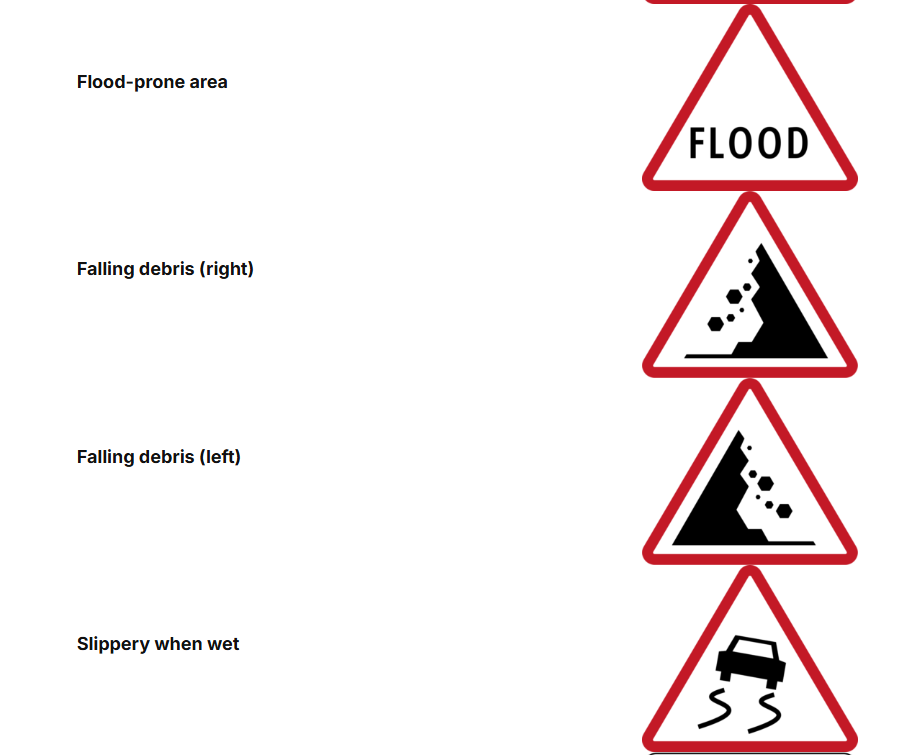
These signs alert drivers to the possibility of hazards or items that might slow them down, such as animals crossing the road, airplanes, landslides, and floods.



6. Pedestrian Signs
There are a variety of shapes and colors available for these signs, but they are usually yellow in color. As children, persons with disabilities, and bicycle riders are frequently seen in this area, it signifies the need to slow down. There may also be a few pedestrian lanes.


7. Railway Level Crossing Signs

8. Supplementary Signs

9. Other Warning Signs
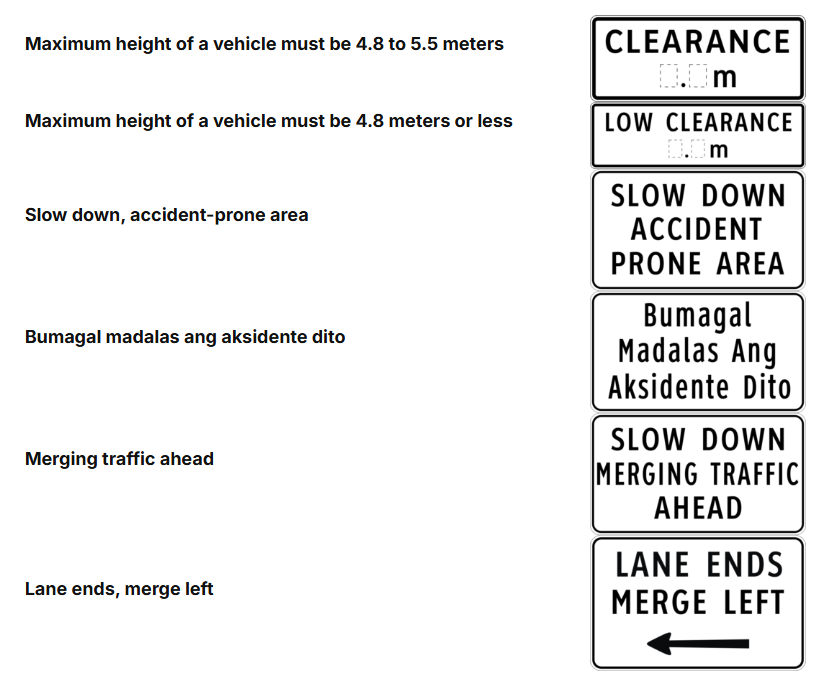
- Vertical Clearance
Guide/Informative Signs
There are markers, milestones, and distance markers that indicate where you are, where certain facilities are, where important points of interest are, and how far you are from the next city or town. These indicators tell you what destination lies ahead or what lies after you make a particular turn or exit. The signs are usually rectangular in shape and are colored green and blue.
1. Advance Direction Signs
They can typically be found on national highways, indicating the direction you should take if you are heading to a particular province.
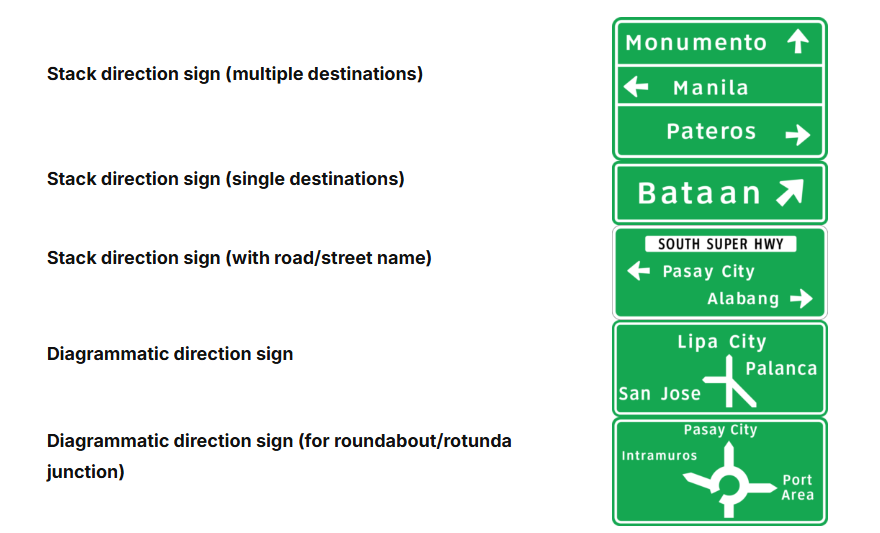
2. Intersection Direction Signs
There are signs that warn you about an intersection to take when you are heading to a particular province at least one kilometer before it occurs.

3. Reassurance Direction Signs
This is a type of sign that shows you how far you are from the exit of a city or province by the number of meters or kilometers you are away from the sign.

4. Fingerboard & Direction Signs
These signs are more specific than the first two as they indicate where you should go in order to locate a tourist attraction, town, or landmark.
5. Street Name Signs
There are signs that tell you which street you are on, or about to enter, or about to exit.
6. Town Names & Geographical Feature Signs
The signs indicate the town you are currently in or about to enter or exit as well as certain geographical characteristics.

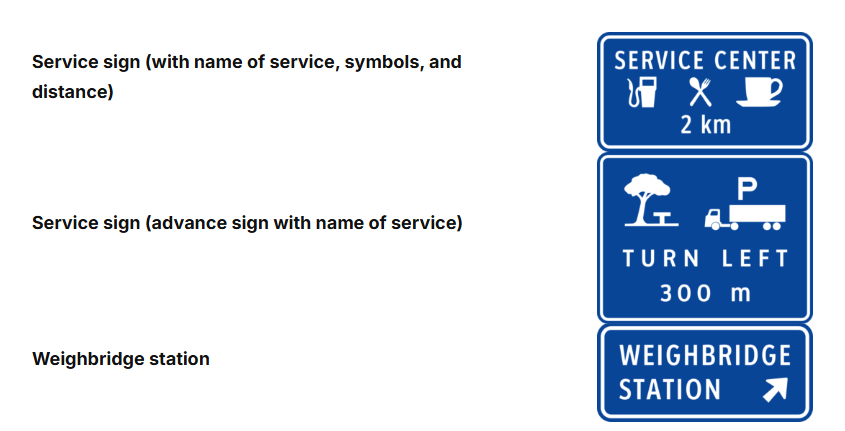
7. Service Signs
They are designed to identify the location of service facilities such as hospitals and restaurants in the area, and usually have a blue background with white symbols.
8. Tourist Information & Tourist Destination Signs
9. Route Markers
These are neutral white, round signs with black numbers or arrows that indicate the location of an arterial road as well as give directions to the location.
10. Asian Highway Route Markers
Signs on Expressways
A highway expressway sign is a neutral white or green colored sign is used to indicate the location of specific services such as the nearest service station or rest area that can be found in a given direction or exit. Additionally, it indicates to motorists that they should slow down or go in the opposite direction. The signs may also provide information that directs drivers to the appropriate lanes or exits, while some expressway signs identify the start and end of the expressway. As opposed to this, some special signs can provide drivers with valuable reminders, such as reminding them to check their brakes and reduce their speed.
1. Expressway Approach Signs
There is a tendency for these signs to be installed in advance or at the nearest intersection or interchange leading to the expressway.
2. Expressway Information Signs

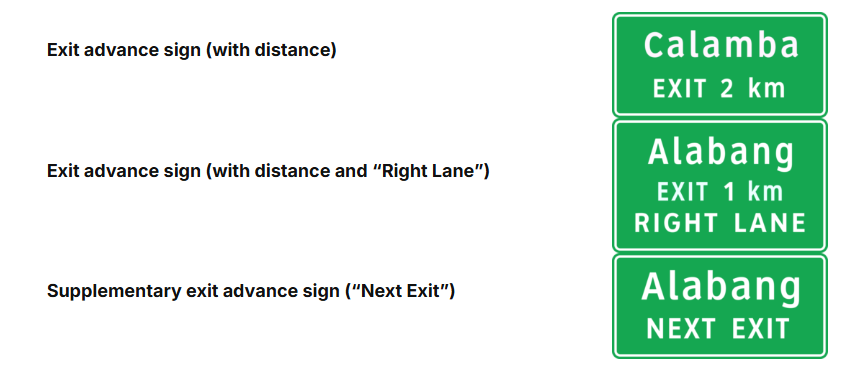
3. Advance Exit Signs
The signs are placed in advance of exit tolls.
4. Expressway Exit Direction Signs
There are expressway exit signs posted overhead before the exit ramp of an interchange to indicate directions to the exit.

5. Expressway Service Signs
The signs point to services that are available on or off expressways, such as rest areas and other facilities.

6. Start and End of Expressway Signs
There are signs indicating where the expressway starts and ends.
Start Expressway

7. Expressway Traffic Instruction & Regulatory Signs
There are special signs that are normally seen only along expressways, and they are usually located about 200 meters away from toll exits.
Traffic Instruction Signs
There are a variety of signs under this category, which complement regulatory signs and assist motorists and pedestrians in following traffic rules by providing specific instructions.
1. Supplementary Signs

2. Movement Instruction Signs


Hazard Markers
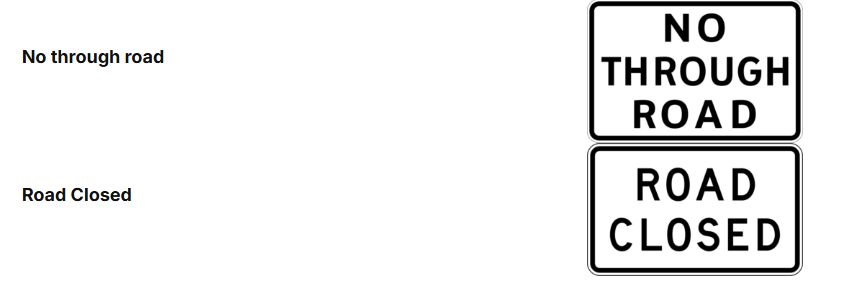
These signs are fairly self-explanatory and are used to indicate a directional change or an obstacle ahead. It serves the purpose of preventing motorists from getting an LTO violation or getting into an accident by pointing them in the direction in which the roadbend is heading. The signs can usually be found along meandering, rural highways along the sides of provincial roads, and consist of a series of red arrows (or chevron signs) indicating the direction in which the road bends.
There are different kinds of hazard markers in the Philippines, including:


Road Work Signs
A road works sign is self-explanatory in its imagery and will often be seen in areas where there is ongoing road work or in places where traffic is backed up. Roadwork signs, however, warn motorists and users to slow down or to merge in the opposite direction since construction or excavation is taking place. Additionally, these signs alert drivers to local hazards such as deep holes and falling debris, which may require them to slow down or change their route.
Pavement Markings
In contrast to traffic signs and symbols, pavement markings usually appear in the form of lines, symbols, messages, or numerals attached to, applied to, or set into the pavement. Pavement markings are usually used in conjunction with traffic control devices, traffic signals, and road signs to guide traffic or give advance warnings to drivers.
1. Longitudinal Lines


2. Traverse Lines

3. Other Lines

4. Object Markings

5. Raised Pavement Markers
Cat’s Eyes
7. Other Markings


Where can I learn more about basic traffic signs in the Philippines?
There are many resources online, but you can also find this information on the LTO’s Land Transportation Management System (LTMS) portal’s eLearning section, since it is an important part of the LTO Driver’s License Exam.
These steps will guide you to the LTMS e-Learning section and the materials within:
- Step 1: Go to the LTMS page and click the E-learning button.
- Step 2: Choose Getting Ready to Drive.
- Step 3: Select Road Traffic Signs from the next page. Alternatively, you can click Pavement Markings if you’d like to learn more about road markings.
The LTMS e-Learning tab can be accessed by both those with and without an LTMS account. There are also materials available on other topics, such as:
- Fundamentals of driving
- Courtesy and safety on the road
- Drivers’ Rights, Duties, and Responsibilities
- Laws relating to land transportation
Why are LTO Traffic Signs Important
There are several reasons why drivers and pedestrians in the Philippines should be aware of the various road traffic signs and symbols available:
- Safety
- Congested and accident-prone areas should be warned of their potential dangers.
- Providing efficient explanations of road usage rules to facilitate better and safer traffic flow.
- Traffic signs can also serve as cues for motorists to drive mindfully.
- The signs are also useful to pedestrians and drivers for finding safe spots for walking, driving, turning, and crossing.
- Applicants must satisfy this requirement to obtain a driver’s license. A section of the LTO written exam involves learning the road signs, which is one of the primary requirements for getting a driver’s license.
FAQs About LTO Traffic Signs and Symbols
Why is learning LTO traffic signs and symbols important?
Ans: Understanding LTO traffic signs and symbols is essential to pass the LTO exam, avoid penalties, and most importantly, ensure road safety for yourself and others.
Do I need to memorize all traffic signs to get a driver’s license?
Ans: Yes. The LTO written exam includes sections on road traffic signs and symbols. Familiarity is required to qualify for a Philippine driver’s license.
Are LTO traffic signs the same across the Philippines?
Ans: Yes. The DPWH standardizes all traffic signs and symbols, ensuring consistency nationwide for easy understanding by all motorists.
Why are some traffic signs written in Filipino or local dialects?
Ans: To make them clearer for local communities. While designs follow international standards, language adaptations help ensure all road users comprehend the signs.
What happens if I ignore regulatory traffic signs?
Ans: Disregarding regulatory signs, such as speed limits or “No Entry” signs, can result in fines, penalties, or license suspension under Philippine law.
Where can I study official traffic signs for the LTO exam?
Ans: You can use the LTO LTMS portal eLearning section, which offers comprehensive lessons on road traffic signs, pavement markings, and safe driving practices.
Are pavement markings also part of LTO road signs?
Ans: Yes. Pavement markings like lane lines and pedestrian crossings complement traffic signs by directing vehicle and pedestrian movements on roads.
How do traffic signs help pedestrians?
Ans: They indicate safe crossing zones, warn of approaching vehicles, and designate overpass or pedestrian lanes, protecting those on foot alongside vehicle traffic.
Conclusion
Mastering LTO traffic signs and symbols is vital for every road user in the Philippines. These signs safeguard lives by guiding drivers and pedestrians on how to navigate roads safely and responsibly. Whether preparing for your LTO license exam or simply aiming to become a more cautious driver, knowing these signs is a crucial part of your road education. Remember, every sign is there to protect you and others so study them well and follow them diligently.