Deed of Sale Motor Vehicle Car 2026: A Essential Guide For Notarized Car Sale And LTO Vehicle Ownership Transfer
Deed of Sale Motor Vehicle Car. If you are buying a secondhand vehicle, then you will need a Deed of Sale for Motor Vehicles. Besides the money, this document is necessary as proof that you are actually purchasing or selling the vehicle. There is a contract of sale and it is quite useful to have, especially when problems arise in the future.
A Deed of Sale for Motor Vehicles is one of the many legal documents required by the Land Transportation Office (LTO). This is an integral part of the documentation involved in the car-buying process. It is very important to check and understand what this document actually is for before signing the dotted line on the reserved area. Although most people would not hesitate to sign such a document to clear it up, it is important to ensure that you are on the right track before signing it.
What is deed of sale for a motor vehicle?
In its simplest form, a deed of sale is a contract for the sale of property. The Philippine law stipulates that any contract must have all three elements, namely the consent of the parties to it, the object that is the subject matter of the contract, and the cause of the obligation established by it. As it relates to a contract of sale or deed of sale, the consummation of the contract is the agreement between the parties as to the price of the motor vehicle.
Notarizing the Deed of Sale is also necessary, otherwise, the transaction will be considered invalid. The contract of sale can be considered nothing more than a tissue paper when the transaction has been deemed invalid. It is useless. This agreement is null and void.
What items are included in the deed of sale?
In almost all cases, the Deed of Sale requires the following information as in any legal document, such as an Affidavit of Loss:
- Identification of the parties and their names
- The addresses of both parties
- The vehicle’s details
- The registration certificate contains general information
- Vehicle series
- Vehicle make
- LTO MV file number
- Vehicle year and model
- Vehicle type
- Plate number
- Certificate of registration number
- Motor and chassis numbers
- Date of sale: The date of sale should be included in the document.
- Warranty and representations: The document should include the representations and warranties made by the seller, such as that the property is free from liens, mortgages, and encumbrances, or if the property is in good condition.
- Notice of rights and obligations: This document should include any rights and obligations of either the buyer or the seller, such as tax and insurance information.
- Special instructions: The document may contain any special instructions, such as instructions for the transfer of utilities, or any other matter that the parties may have agreed on.
- The purchase price of the vehicle, and
- Statement of acknowledgement (notarization)
The notarization makes the Deed of Sale a public legal document, which makes its authenticity easier to prove and makes its execution easier. It is easier to prove the transaction in a court of law with an acknowledgement statement.
There are also generally the following documents submitted with the Deed of Sale:
- Photocopies of two (2) valid government-issued identification cards or documents
- Signatures of three (3) specimens
It is typically necessary to submit the following requirements with the Deed of Sale when used at the LTO to facilitate the transfer of vehicle ownership:
- Assumption of Car Mortgage Notarized Statement
- The release of chattel mortgages
- OR/CR (Original Office Receipt and Certificate of Registration)
- A copy of the original receipt for payment of the Motor Vehicle User’s Charge (MVUC) issued by the LTO
- The Philippine National Police – Highway Patrol Group (PNP-HPG) has issued a motor vehicle clearance certificate
- CTPL, or compulsory motor vehicle liability insurance
- MVIRs, or Motor Vehicle Inspection Reports, are completed and approved
- Number of Tax Identification (TIN)
- A secretary’s certificate is required if the vehicle was owned by a corporation or company
Why is it important to have a deed of sale for a motor vehicle?
It is the deed of sale for a motor vehicle that provides evidence of the sale of the vehicle. It is true that a verbal agreement of sale can lead to a successful transaction. There is, however, the possibility of it being retracted at any time, and not even the highest courts can intervene if either of the parties involved changes their mind and claims otherwise.
It is beneficial to have a motor vehicle deed that has been notarized and signed in several ways, including:
- It is enforceable to enforce the contract of sale.
- The validity of the deed of sale prevents either party from changing its mind following the completion of the transaction.
- A motor vehicle’s liabilities will fall under the responsibility of the person assigned responsibility, as specified in the deed of sale.
- This document serves as proof of sale, effectively completing the transfer of ownership and responsibility between the seller and purchaser.
This can serve as one of the requirements for registering a motor vehicle with the LTO.
- Legal proof of ownership: A Deed of Sale is a legal document that proves the ownership of a motor vehicle, and it can also be used as a property record update.
- Clear statement of ownership: It is typically used when there is a clear statement of ownership for a motor vehicle, and it allows the parties to transfer ownership in spite of liens or encumbrances.
- Flexibility: The contract may be customized to provide specific terms and conditions according to the buyer and seller’s requirements.
- Protection for both parties: It is possible to protect both parties’ interests by including warranties and representations in a Deed of Sale, such as the motor vehicle is free from liens, mortgages, and encumbrances, as well as by including contingencies for the buyer, such as the requirement that certain repairs or improvements be made to the motor vehicle prior to the sale becoming final.
- Simplicity: The Deed of Sale is a straightforward document that transfers ownership of property without requiring any contingencies or conditions to be met in order for the sale to be considered valid.
What consequences might there be if this document doesn’t exist?
It is important to note that some of the disadvantages or consequences of not having a Deed of Sale of Motor Vehicles are as follows:

- It would not be possible to provide proper evidence of the sale of the motor vehicle.
- There is no way that the LTO would allow you to transfer ownership of the vehicle from your name to the buyer’s name.
- The improper registration of a vehicle is also considered a violation of traffic laws.
- It is always possible that you may be held responsible for accidents, crimes, or violations committed while using the vehicle.
- In the event that there is a dispute regarding who will be responsible for completing certain repairs, improvements, liens, mortgages, or other encumbrances associated with the vehicle before the sale can be considered final, there will be no legal and binding agreement.
When is a sale deed needed and who prepares it?
The deed of sale for a motor vehicle is a document that you must use when you sell or purchase a secondhand or used vehicle. Although it is generally prepared by the seller since they have more to lose, it does not preclude the buyer from facilitating its preparation and execution.
How to Prepare a Deed of Sale of Motor Vehicles?
There are many similarities between a Deed of Sale of a Motor Vehicle and an Affidavit of Change of Color, with the exception of the actual document itself. In light of this, you can refer to the guide on executing an Affidavit of Change Color for information regarding how to prepare a Deed of Sale.
It is important to note that the documents used to execute an affidavit of change in color are different from those required to execute a deed of sale. Additionally, while the Affidavit of Change in Color is a joint document, signed by both the owner and the contractor, the Deed of Sale is not a joint document, but rather a contract, signed by both the buyer and the seller to demonstrate agreement on all terms.
How much does it Price to Prepare a Deed of Sale?
In order to prepare a deed of sale or obtain one from the local title office, there is no cost, but since the document requires notarization like any other legal document, there is a notarial fee to consider. Unlike the notarization of affidavits, which cost around P100.00 to P800.00 each, the notarization fee of a deed of sale, regardless of whether it is for real or personal property, ranges between 1-2% of the purchase price. Therefore, depending on the price of the motor vehicle being sold, the cost of this document may vary.
Where to get a Deed of Sale of a Motor Vehicle notarized?
Since there are no LTO-accredited notaries public in existence, sellers and buyers of second-hand or used motor vehicles may have their Deed of Sale of Motor Vehicle notarized by any notary public across the country. Nevertheless, it is important to keep in mind that the location and prestige of the notary public may affect the fee charged.
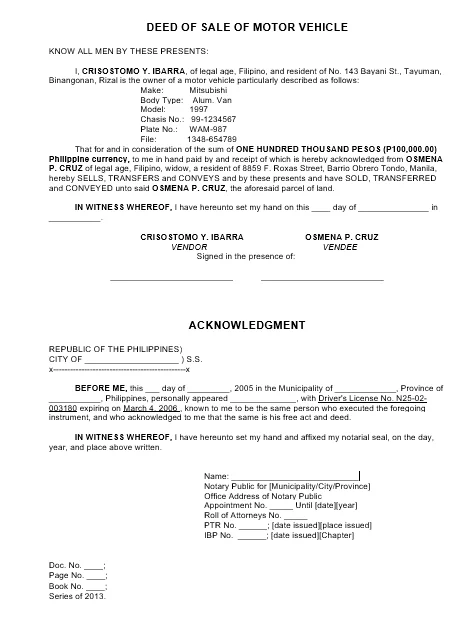
Deed of Sale for Motor Vehicle Sample
It is possible for you to write a Deed of Sale for Motor Vehicles without having to start from scratch if you are unsure what it looks like on paper.
Deed of Sale of a Motor Vehicle
KNOW ALL MEN BY THESE PRESENTS:
This Deed of Sale of Motor Vehicle, is signed and executed this ___ the day of February 2011, by and between: ___________________, Filipino, of legal age, single/married, and a resident of _______________________________________, hereinafter referred to as “VENDOR”; ___________________, Filipino, married, and a resident of ____________________________, hereinafter referred to as the “VENDEE”.
Witnesses:
WHEREAS, the VENDOR is selling on an “as is where is” basis a previously owned vehicle, hereinafter described as follows:
MAKE: ___________________
PLATE NO: ___________________
SERIES: ___________________
COLOR: ___________________
TYPE: ___________________
MV FILE NUMBER: ___________________
MOTOR NUMBER: ___________________
SERIAL/CHASSIS NUMBER: ___________________
Whereas the VENDOR agreed to sell, and the VENDEE agreed to acquire, the VENDOR’S rights, interests, and title to the motor vehicle in question;
Therefore, the VENDOR hereby sells, transfers, assigns, and conveys to the said VENDEE all the rights, title and interest over the aforementioned motor vehicle in consideration of the above-mentioned premises and the sum of PESOS: THREE HUNDRED THOUSAND (Php 300,000.00), Philippine currency.
By this agreement, the VENDOR warrants that the vehicle is free of all liens and encumbrances.
It is acknowledged by the VENDEE that it has thoroughly inspected the vehicle and that it has purchased this vehicle on an “as is, where is” basis.
IN WITNESS WHEREOF, the participants have hereunto attached their signatures this ____ day of February 2011, in the City of ___________________, Philippines.
_________________ _________________
VENDOR VENDEE
Witnessed by:
___________________ ___________________
Acknowledgment
Republic of the Philippines)
City of……………..)S.S.
BEFORE ME, a NOTARY PUBLIC, for and in the city of _____________, Philippines, this ___ day of February 2011, appeared the following persons who presented the following valid identification cards:
NAME: ___________________
ID NO.: ___________________
DATE OF ISSUE/EXPIRY : ___________________
PLACE OF ISSUE : ___________________
The above two (2) persons are known to me to have executed the foregoing instrument, which is made up of two (2) pages along with the page where this acknowledgment is typed, and both have acknowledged to me that the same is their voluntary act and deed.
THE DATE AND PLACE ABOVE WAS WITNESSED BY MY HAND AND SEAL.
Doc. No.: _____;
Page No.: _____;
Book No.: _____;
Series of 20:____.
Deed of Sale for Motor Vehicle Sample Form
How to Execute the Deed of Sale Properly
To ensure your Deed of Sale Motor Vehicle Car is legally valid, follow these steps:
Step 1: Fill in all details completely
Make sure there are no blank spaces. Incomplete information can result in delays during registration.
Step 2: Verify identities
Ask for valid IDs of both the buyer and seller. Take photocopies and attach them to the deed.
Step 3: Sign and date
Both parties should sign the document in the presence of each other. If possible, sign in front of witnesses or a notary public.
Step 4: Make copies
Each party should retain a signed original copy. Additional copies can be used for submission to government agencies.
Deed of Sale for Motor Vehicle: Video Guide
Important Reminders
There will definitely be a need for a Deed of Sale when you are selling or purchasing a used vehicle. Here are some things you should bear in mind before preparing one:
- A Deed of Sale of Motor Vehicle is usually prepared by the seller, but this is not a requirement for everyone.
- A buyer may prepare a statement if he so desires, as there is nothing in the law or anywhere else that requires that the seller prepare it.
- Generally, the seller prepares the Deed of Sale of Motor Vehicles since they generally have more to lose when it comes to the timely and proper execution of the document.
- It is important to ensure that the deed of sale is prepared properly in order to facilitate the transfer of ownership through the LTO.
- It is important to ensure that the deed of sale is properly prepared to demonstrate the motor vehicle is no longer in the possession of the seller.
- It is important to note that motor vehicles are subject to the owner’s rule, which means that in the event of an accident, the registered owner is presumed to have responsibility.
- Land Transportation Office (LTO) must be notified of the new owner’s intent to register the vehicle.
- A deed of sale does not cover registration at the LTO as it only proves that the car was sold and bought by the parties named in the document.
- Should the driver of the vehicle get in an accident, the person listed on the LTO certificate of registration could be held liable. It is therefore strongly advised that ownership of the vehicle is transferred after the sale.
- A buyer should never proceed with the purchase of a vehicle from a seller who does not have a deed of sale or who refuses to execute one.
- A seller who fails to provide the official receipt (OR) as well as the certificate of ownership (OR) may also be considered a red flag, so do not proceed with the transaction.
Deed of Sale for Motor Vehicle Details in PDF
FAQs About Deed of Sale for a Motor Vehicle
What is a Deed of Sale for a Motor Vehicle and why is it necessary?
Ans: A Deed of Sale for a motor vehicle is a legally binding document that proves the sale and transfer of ownership between the seller and the buyer. It protects both parties from future disputes, provides proof of ownership, and is a requirement for transferring vehicle registration with the Land Transportation Office (LTO).
What documents are needed along with the Deed of Sale when transferring ownership at the LTO?
Ans: You will need the following documents:
- Notarized Deed of Sale
- Original Certificate of Registration (CR) and Official Receipt (OR)
- Valid IDs of both parties
- PNP-HPG Motor Vehicle Clearance
- CTPL Insurance
- MVIR (Motor Vehicle Inspection Report)
- TIN (Tax Identification Number)
- Assumption or release of mortgage if applicable
Who prepares the Deed of Sale and can it be handwritten?
Ans: Typically, the seller prepares the Deed of Sale since they have more liability, but the buyer can also initiate it. While it can be handwritten, it must contain all required details, be free of errors, and must be notarized to be considered valid.
What happens if the Deed of Sale is not notarized?
Ans: An unnotarized Deed of Sale is not considered a public legal document and can be deemed invalid in legal or administrative proceedings. Without notarization, the transfer of ownership may be rejected by the LTO and could lead to future legal complications.
How much does it cost to notarize a Deed of Sale for a vehicle?
Ans: Notarization fees typically range between 1–2% of the purchase price of the vehicle. For example, if the vehicle is sold for ₱300,000, the notary fee may range from ₱3,000 to ₱6,000, depending on the notary public and location.
Conclusion
A Deed of Sale for Motor Vehicles is essential for the legal and safe transfer of ownership of any secondhand vehicle in the Philippines. It safeguards both the buyer and seller, ensures compliance with LTO regulations, and provides legal proof of transaction. Never complete a sale without this document, and always ensure it is properly notarized to avoid future disputes or liabilities.