How To Add Restriction Codes to Your LTO Driver License: Requirements, Tests And Complete Process Guide
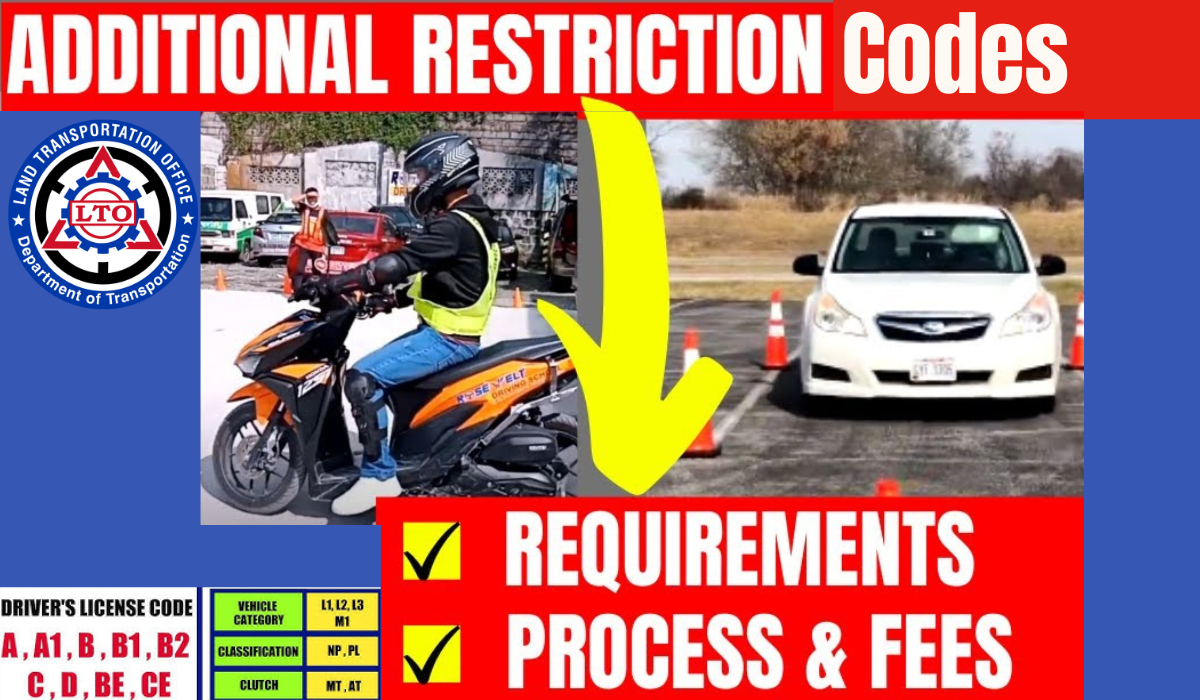
How To Add Restriction Codes to Your LTO Driver License. Updating your LTO driver’s license (DL) restriction codes is crucial if you want to operate a larger vehicle or expand the types of vehicles you are allowed to drive. With the introduction of new vehicle categories and restriction codes in the Philippines, being precise with your restriction code ensures you can legally operate specific motor vehicles on public roads.
Whether you’ve recently learned to drive a new vehicle type or forgot to declare certain restriction codes during your previous driver’s license application, it’s now possible to add restriction codes to your LTO driver’s license. Although the process requires preparation, the benefits such as driving fuel-efficient vehicles, earning better opportunities with larger vehicles, or complying with legal requirements make it worthwhile.
What Are LTO Driver’s License Restriction Codes?
Restriction Codes (RC) are alphanumeric codes assigned by the Land Transportation Office (LTO), ranging from A to CE, indicating the type of vehicles a driver can operate or any special driving conditions.
These codes specify the vehicle categories allowed for the license holder. Driving a vehicle outside your permitted restriction code can result in fines, penalties, or impoundment. For example, if your DL restriction code is “A” (motorcycle), you are not allowed to drive a bus. Violation of this can also affect your eligibility for a 10-year validity license.
Driver’s License Restriction Codes in the Philippines
The Philippines has introduced specific Driver’s License (DL) Restriction Codes to classify the types of vehicles a driver is permitted to operate. Below is a detailed overview of all nine DL restriction codes along with their corresponding vehicle category codes.
1. DL Code A: Motorcycle
Drivers who wish to operate motorcycles such as Mio, Aerox, NMax, Smash, or Barako—must have a license with DL Restriction Code A. This code covers all types of transmissions, including automatic, manual, and semi-automatic. License holders under this code can drive the following vehicle categories:
- L1: Two-wheeled vehicles with a maximum design speed of 50 kph.
- L2: Three-wheeled vehicles with a maximum design speed of 50 kph.
- L3: Two-wheeled vehicles with a maximum design speed exceeding 50 kph.
2. DL Code A1: Tricycle
This restriction applies to all three-wheeled motor vehicles and motorcycles with sidecars, including transport tricycles and e-tricycles like Bajaj Re, Yamaha Tricity4, and tuk-tuks. It also covers small four-wheeled vehicles with limited unladen mass and maximum speed. License holders can drive:
- L4: Motorcycle with sidecar, maximum speed 50 kph.
- L5: Symmetrically arranged three-wheeled vehicles, speed exceeding 50 kph.
- L6: Four-wheeled vehicles with unladen mass ≤350 kg and maximum speed 45 kph.
- L7: Four-wheeled vehicles with unladen mass ≤550 kg and maximum speed 45 kph.
3. DL Code B: Passenger Car
This DL code is for cars with up to 8 seats and a gross vehicle weight (GVW) not exceeding 5,000 kg, including hatchbacks, sedans, coupes, and SUVs. The vehicle category under this code is:
- M1: Vehicles with fewer than eight seats and GVW ≤5,000 kg.
4. DL Code B1: Passenger Van or Jeepney
Drivers of passenger vans, like Honda Odyssey, Toyota Hiace, Ford Transit, and jeepneys, must have this code. Vehicle category:
- M2: Passenger vehicles with more than eight seats and GVW ≤5,000 kg.
5. DL Code B2: Light Commercial Vehicle
This restriction applies to cargo four-wheelers used for commercial transport of goods, including Suzuki Carry, Hyundai H100, Isuzu Travis, and Mitsubishi L300. Vehicle category:
- N1: Vehicles for goods carriage, maximum GVW 3,500 kg.
6. DL Code C: Heavy Commercial Vehicle
Large trucks, including garbage trucks, container trucks, and fire trucks, fall under this category. Vehicle categories include:
- N2: Goods vehicles with GVW between 3,500 kg and 12,000 kg.
- N3: Goods vehicles with GVW exceeding 12,000 kg.
7. DL Code D: Passenger Bus
Bus drivers need DL Code D to operate any bus model. Vehicle category:
- M3: Vehicles with more than eight seats and GVW over 5,000 kg.
8. DL Code BE: Light Articulated Vehicle
This code covers light articulated vehicles, including cars with trailers, which have pivot joints and lower GVW. Vehicle categories:
- O1: Articulated vehicles with GVW <750 kg.
- O2: Articulated vehicles with GVW ≤3,500 kg.
9. DL Code CE: Heavy Articulated Vehicle
Designed for heavier articulated vehicles, similar to BE but with higher GVW. Vehicle categories:
- O3: Articulated vehicles with GVW between 3,500 kg and 10,000 kg.
- O4: Articulated vehicles with GVW exceeding 10,000 kg.
Medical Conditions and Driving Indications on LTO Driver’s License
If a driver has any medical conditions that may affect their ability to safely operate a motor vehicle, the Land Transportation Office (LTO) will indicate additional driving restrictions on their license. These restrictions are denoted through specific condition codes, ensuring both the driver’s safety and public road safety. The five medical condition codes are as follows:
1 – Drive Only with Corrective Lenses
This condition code signifies that the license holder has been certified by an accredited physician as having vision below the 20/40 standard. The driver is not allowed to operate a vehicle without wearing eyeglasses or other corrective lenses as prescribed.
2 – Drive Only with Special Equipment for Upper or Lower Limbs
License holders with this condition code have impairments in their upper and/or lower limbs. The restriction ensures that they can safely operate a motor vehicle using specially adapted equipment designed for their specific needs.
3 – Drive Customized Motor Vehicles Only
This restriction code indicates that the driver can only operate specially customized or modified motor vehicles. All such vehicles must be duly registered and approved by the LTO to ensure compliance with road safety regulations.
4 – Drive Only During Daylight
For drivers with this condition code, operating a vehicle is permitted only during daylight hours. This restriction typically applies to individuals who are partially or totally blind in one eye or have other vision limitations that prevent safe driving at night.
5 – Drive Only with Hearing Aid
This condition code applies to license holders with hearing impairments. Drivers under this restriction are required to wear a hearing aid while driving to ensure they can respond appropriately to traffic signals and road sounds.
How to Add Restriction Codes to Your LTO Driver’s License
Adding restriction codes to your Land Transportation Office (LTO) driver’s license (DL) requires meeting certain qualifications, preparing specific documents, and following a step-by-step process. Below is a comprehensive guide to help you apply for additional DL restriction codes.
Eligibility
Any holder of a Non-Professional Driver’s License (NDL) or a Professional Driver’s License (PDL) may apply for additional restriction codes, provided they meet the following conditions:
- Must be physically and mentally fit to operate a motor vehicle.
- Must be able to read and write in both Filipino and English.
- Must have passed the LTO Automated written and practical driving exams.
- Must not have any unsettled traffic violations.
Applicants with demerit points are subject to a prohibition period for applying additional DL codes, calculated from the date of settlement of fines and penalties:
- 1–2 demerit points: 3 months
- 3–4 demerit points: 6 months
- 5 or more demerit points: 1 year
Additional Qualifications
Specific DL codes require additional qualifications:
- RC 1 / DL Codes A or A1: Must already hold a valid DL.
- RC 2 or 4 / DL Codes B, B1, or B2: Must already hold a valid DL.
- RC 3 or 5 / DL Codes C: Must hold PDL Code B2 (RC 2) for at least 4 years.
- RC 3 or 5 / DL Codes D: Must hold PDL Code B1 (RC 2) for at least 4 years.
- RC 6 or 7 / DL Codes BE: Must hold B, B1, or B2 (RC 2) for at least 3 years.
- RC 8 / DL Codes CE: Must hold C or D (RC 3) for at least 6 months.
Requirements
Before applying for additional restriction codes, prepare the following documents to ensure a smooth process:
- Duly accomplished Application for Driver’s License (ADL) Form, available at the LTO Forms page.
- Original and one photocopy of electronically transmitted medical certificate from an LTO-accredited clinic.
- Original and one photocopy of any of the following: PSA/NSO Certificate of Birth, Philippine Identification Card, Passport, Local Civil Registry (for areas without PSA), or PSA Certificate of Marriage.
- Original and one photocopy of a valid ID with photo and signature (PhilID, passport, SSS, UMID, PhilHealth, TIN, Postal ID, Voter’s ID, Barangay ID, PRC ID, Senior Citizen ID, OFW ID, OWWA ID, NCDA ID, Solo Parent ID, Voter’s Certification, GSIS e-Card, Seaman’s Book, GOCC ID, Pag-IBIG ID, DSWD Certification, IBP ID).
For foreigners, present the original and one photocopy of your passport with an entry date of at least one month and a visa valid for six months. If born in the Philippines, present the original and one photocopy of a duly accomplished PSA birth certificate.
Other required documents include:
- Taxpayer Identification Number (TIN) if employed.
- Original and one photocopy of Certificate of Completion of the 8-hour Practical Driving Course, electronically transmitted by the accredited driving school, LTO DEC, or LTO-accredited TESDA Training Center, proving experience with the type of vehicle for the requested restriction code.
- Electronically transmitted Certificate of Completion of Driving Enhancement Program (DEP) if applying for the first renewal of a 5-year validity driver’s license.
- Presentation of the original driver’s license, expired or otherwise.
- Drug test result.
By ensuring that all qualifications and documents are complete, the application for additional restriction codes can be processed efficiently at the LTO.
Procedures to Add Additional Restriction Codes to Your LTO Driver’s License
Once you have prepared all the necessary documents, you can proceed to apply for additional Driver’s License (DL) restriction codes by following these detailed steps:
- Step 1: Schedule an appointment with your preferred LTO branch office through the Land Transport Management System (LTMS) portal online.
- Step 2: On your appointment date, visit the selected LTO office with all the required documents for the application.
- Step 3: Upon arrival, secure a queue number from the service counter and wait for your turn.
- Step 4: Once it’s your turn, obtain the Driver’s License application form from the assigned LTO officer.
- Step 5: Complete the application form by filling in all necessary details, as incomplete applications will not be accepted.
- Step 6: When called, submit the completed application form along with all the required documents to the LTO officer.
- Step 7: Proceed to the cash counter to pay the applicable fees and make sure to secure your official receipt for reference.
- Step 8: After payment, you must complete a practical driving test for the specific vehicle type corresponding to the additional restriction code you are applying for.
- Step 9: You are also required to undergo a vision test as part of the application process.
- Step 10: Once all tests and document verification are successfully completed, the LTO will issue your new Driver’s License with the additional restriction codes.
Fees for Adding Restriction Codes to Your LTO Driver’s License
The fees for updating or adding restriction codes to your LTO Driver’s License (DL) may vary depending on the type of license you currently hold and whether it is due for renewal. Below is a detailed breakdown of the applicable fees:
1. Valid Non-Professional/Professional Driver’s License
- Application Fee: PHP 100.00
- Computer Fee: PHP 67.63
- Total: PHP 167.63
2. Valid Non-Professional/Professional – Due for Renewal
- Application Fee: PHP 100.00
- Computer Fee: PHP 67.63
- Total: PHP 167.63
3. Valid Non-Professional/Professional – With Replacement and Additional Restriction Code
- Replacement Fee: PHP 225.00
- Additional Restriction Code: PHP 100.00
- Computer Fee: PHP 67.63
- Total: PHP 392.63
4. Valid Non-Professional/Professional – Due for Renewal with Replacement and Additional Restriction Code
- Replacement Fee (Renewal Professional): PHP 350.00
- Additional Restriction Code: PHP 100.00
- Computer Fee: PHP 67.63
- Total: PHP 517.63
Processing Time for Additional Restriction Codes
The complete process for applying and obtaining additional restriction codes on your LTO Driver’s License typically takes up to 30 days. However, the exact processing time may vary depending on the schedule and timeline provided by the LTO branch handling your application.
LTO Additional Restriction Codes – Video Guide
Important Reminders Before Applying for Additional DL Restriction Codes
Before visiting the Land Transportation Office (LTO) to apply for additional Driver’s License (DL) Restriction Codes, make sure to keep the following tips in mind:
- Plan for the Day: The entire application process may take an entire day, so allocate enough time.
- Prepare for the Exam: Thoroughly review all study materials to ensure you are fully ready for both the written and practical tests.
- Bring Complete Documents: Ensure that all required documents and IDs are prepared and complete to avoid delays.
- Fingerprint Requirement: Applicants who have already been issued a DL card must undergo fingerprinting before receiving a 5-year Driver’s License Card.
- Passenger Restrictions: Drivers with Conditional or Special Restricted Licenses are not allowed to carry more than two passengers under 21 years old unless accompanied by a licensed adult aged 21 or older. Exceptions apply only when transporting family members or students to and from school.
- Secure Driving School Certifications: Make sure to obtain the certification, receipt, and completed application form from your accredited driving school before heading to the LTO office.
Benefits of Updating Your LTO Driver License Restriction Codes
Updating or adding restriction codes to your LTO Driver’s License offers several advantages:
- Legal Compliance – Ensures you are legally allowed to operate specific vehicle types on public roads.
- Expanded Driving Opportunities – Enables you to drive larger vehicles, motorcycles, buses, and commercial vehicles, depending on your updated restriction codes.
- Career and Job Advantages – Professional drivers can access more job opportunities requiring specific vehicle categories.
- Safety Assurance – Restriction codes and medical condition indicators ensure that drivers operate vehicles they are qualified and capable of handling safely.
- Avoid Fines and Penalties – Driving a vehicle outside your permitted restriction code may lead to fines, license suspension, or impoundment.
- Upgrade for Fuel Efficiency – Adding new codes can allow you to drive newer, more fuel-efficient vehicles suitable for personal or business use.
FAQs About LTO Driver License Restriction Codes
Can I apply for additional restriction codes if I have a traffic violation?
Ans: No. Applicants must have no unsettled traffic violations. Demerit points may result in a temporary prohibition: 1–2 points = 3 months, 3–4 points = 6 months, 5+ points = 1 year.
How long does it take to process additional restriction codes?
Ans: Typically, the complete process takes up to 30 days, but this can vary depending on your LTO branch schedule.
Do I need to take a practical driving test for each new restriction code?
Ans: Yes. Practical and vision tests are required for all new restriction codes to ensure competency with the vehicle type.
Can minors or drivers under 21 carry passengers with Conditional or Special Restricted Licenses?
Ans: No. Drivers with these licenses cannot carry more than two passengers under 21, unless accompanied by a licensed adult (21+), or when transporting family members or students to school.
Can foreigners apply for additional restriction codes?
Ans: Yes. Foreigners must present their passport with at least 1-month entry and a valid visa of at least 6 months along with other required documents.
Conclusion
Updating your LTO Driver License restriction codes is essential for legal compliance, safety, and career opportunities. By preparing the necessary documents, understanding your eligibility, and following the step-by-step LTO process, you can seamlessly add or upgrade your restriction codes.